
Benefits Summary
🔸 Access rates, terms, and incentives from all top lenders in Ireland.
🔸 Find the most competitive deals available based on your profile.
🔸 We manage the paperwork, negotiations, and process on your behalf.
🔸 Review and change your mortgage to save money with ease.
🔸 We don’t charge a broker fee. We receive commission from the lender when your mortgage draws down.
🔸 We work for you, not the banks no allegiance to any provider.
🔸 Maximise Your Borrowing Power.
🔸 Simplify Complex Mortgages.
MORTGAGE COMPARISON/ADVICE
Not Just a Mortgage: A Smarter Way to Buy a Home
Buying your first home, trading up, or simply switching providers? The mortgage world can be complex, full of jargon, changing rates, and limited offers. That’s why we compare the market for you, helping you find a suitable mortgage at a competitive rate, without the stress.
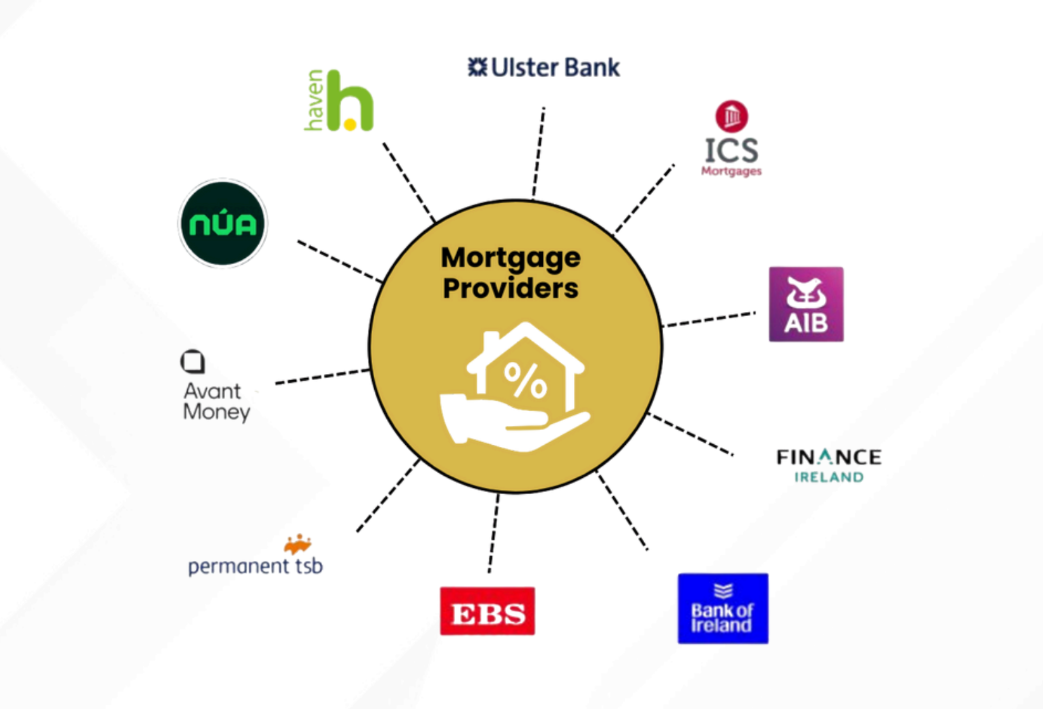
Compare Mortgages: Why settle for one bank's offer when you can view all of Ireland’s top mortgage lenders side by side? Choosing a mortgage can be as important as choosing a home. With interest rates, terms, and offers varying across providers, comparing the market helps buyers:
Access competitive interest rates, understand how much you may be able to borrow based on your income, compare cashback offers and incentives, and reach alternative lenders that are not available to the public directly.

Various Mortgage Types
- First-Time Buyer Mortgages
- Switcher Mortgages
- Buy-to-Let Mortgages
- Public Sector Mortgages
- Pension & Investment Mortgages
- Mortgages for Single Applicants
- Equity Release & Cash-Out Mortgages
Each type includes distinct eligibility criteria and benefits, suitable for different life stages and goals.
Government Incentives Supported
Guidance is available to help applicants access:
- 1. Help to Buy
- 2. First Home Scheme
- 3. Affordable Home Schemes
- 4. Retrofitting Grants
Step-by-Step Process:
Step 1: Initial consultation to gather personal and financial information.
Step 2: Comparison of all major Irish lenders on: Borrowing limits, Interest rates, Cashback options, Sector-specific terms.
Step 3: Recommendation of the most suitable mortgage product.
Step 4: Full application handled on behalf of the applicant.
Step 5: Coordination with banks, solicitors, and valuers.
Step 6: Education on applicable grants and government schemes
Credit Challenges & Loan Consolidation
Options available for applicants with poor credit history.Alternative lenders are considered when banks have declined applications.
Support in consolidating multiple debts into a single mortgage payment

Fees & Charges
Unlike some brokers, Money Sense Financial Services (a part of Money Maximising Advisors group) doesn’t charge a broker fee. We receive commission from the lender when your mortgage draws down. That means
- No broker fee is charged to clients
- The broker is paid by the lender only upon successful drawdown
- We receive commission from the lender, not a fee from you
- Client-first approach with no obligation to any provider
Why Apply for a Mortgage Through a Broker?
A multi-agency broker compares all offers on the market, including those from banks, credit unions, and private lenders.
- Brokers often identify better value than a single-bank approach
- All standard terms and rates are accessible through a broker
- No broker fee for the client
- Some brokers charge fees — Money Maximising Advisors does not
FREQUENTLY ASKED QUESTIONS (FAQ)
Which bank is best for mortgages in Ireland?
There’s no one-size-fits-all answer. The right mortgage depends on your income, deposit, and whether you're a first-time buyer. That’s why mortgage comparisons in Ireland are so valuable. Brokers like Money Sense Financial Services compare offers from all major lenders, including alternative and non-bank providers, to find competitive mortgage rates in Ireland, tailored to your profile.
Is it possible to secure a fixed-rate mortgage for 30 years in Ireland?
They are available, but not as widely offered as shorter-term fixed rates. Most fixed-rate mortgages in Ireland range from 3 to 5 years, but some lenders now offer longer-term products. At Money Sense Financial Services, we help you find lenders offering mortgages with interest rates in Ireland that suit your long-term goals, including extended fixed terms if available.
What is the average cost of a mortgage in Ireland?
This depends on your loan size, interest rate, and term. For example, at the Central Bank’s average new mortgage rate of 3.48% (July 2026), a €300,000 mortgage over 30 years would cost around €1,344 per month. This is an illustration only; your actual rate and repayments will depend on your lender and circumstances. Use a free tool like the Irish Mortgage Calculator or speak to a broker to calculate the exact cost for your situation.
Is it worth using a mortgage advisor?
Absolutely. A broker gives you access to multiple lenders, not just one bank, meaning you can compare competitive mortgage rates in Ireland for your needs. Plus, Money Sense Financial Services charges no broker fee. We receive commission from the lender when your mortgage draws down.
What are the rules for mortgage borrowing in Ireland?
Here are the basics:
- First-time buyers: borrow up to 4x gross income
- Second and subsequent buyers: borrow up to 3.5x gross income
- Deposit needed: 10% for first-time and second or subsequent buyers, 30% for buy-to-let
- Lenders can make limited exceptions to these limits (up to 15% of their home-buyer lending)
- You must show repayment capacity and a clean credit history
Brokers like Money Sense Financial Services simplify these rules and help you apply for a mortgage in Ireland, guiding you from approval in principle to final drawdown.
What are the best mortgage rates?
Rates change regularly and depend on your deposit size, income, and lender. Some providers offer cashback; others offer lower rates with fewer perks. With full mortgage comparisons in Ireland, we help you weigh total repayment costs, not just the headline rate, so you can choose the right product.
Will mortgage rates rise or fall in Ireland in 2026 and 2027?
Forecasts are uncertain. The European Central Bank (ECB) raised its key interest rates by 0.25 percentage points on 10 September 2026, taking its deposit rate to 2.50%, and Irish mortgage rates may move again depending on inflation. Most new Irish mortgages are now on fixed rates, so comparing fixed-rate options and reviewing your mortgage regularly can help you manage the risk of future changes.
Should I get a 25 or 35-year mortgage?
A 35-year mortgage lowers monthly repayments, making it attractive for younger buyers. However, a 25-year mortgage typically means lower overall interest paid.
Warning: If you do not keep up your repayments you may lose your home.
Warning: The cost of your monthly repayments may increase.
Warning: If you take out a variable-rate loan, the payment rates may be adjusted by the lender from time to time.
Warning: You may have to pay charges if you pay off a fixed-rate loan early.
Get in touch with us
We’re here to help reach out anytime for expert advice, personalised support, or answers to your financial questions.

